Sally Phillips 0:00
The worst thing happened, the thing I was most frightened of happened, which is he would leave me and I would end up having to, you know, pay for everything and do the kids on my own. The very worst thing happened, and I could do it. Turned out I could do it.
Kate Daly 0:18
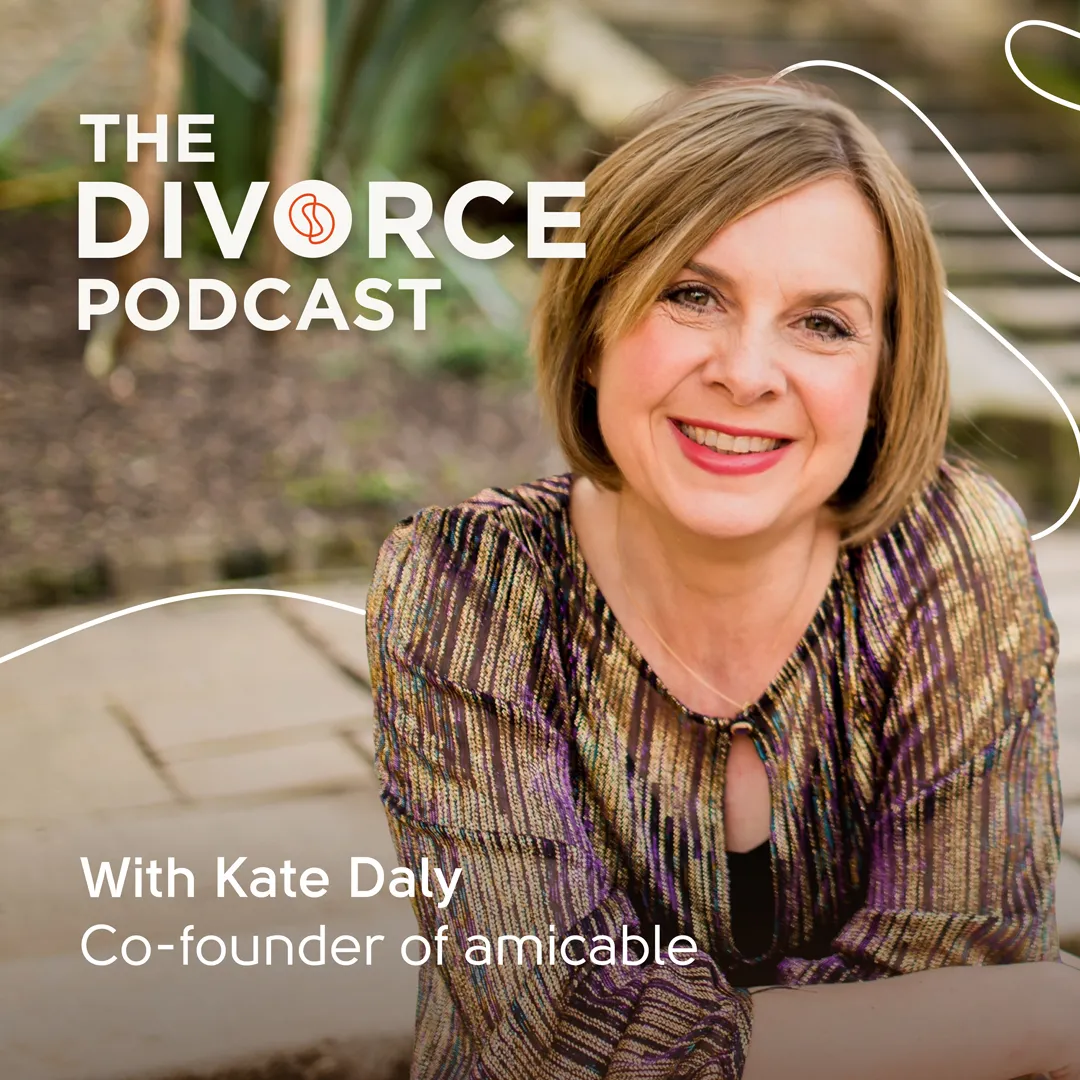
Welcome to The Divorce Podcast, where we explore all aspects of ending relationships, separation, and parenting apart. If your marriage or partnership has ended, or you have friends and family who are separating, this podcast is for you. I'm Kate Daly, a relationship counsellor, divorce specialist, and co-founder of amicable, the online legal service for separating couples. In each episode, we look at relationships and separation from different angles, including the emotional, legal, and social. I'm joined by experts and special guests who share their own unique stories, experience and tips, with the goal of helping people end relationships in a kinder and better way. This week I'm delighted to be joined by Sally Phillips. Sally is an English actor, writer and comedian, producer and director, and an executive producer at Captain Dolly. She's best known for TV comedies including I'm Alan Partridge, Jam Jerusalem, Miranda and Thief, the Bridget Jones films and shows like Taskmaster and QI. She began life in the Oxford Review and went on to co-write and develop the groundbreaking female-led sketch show Smack the Pony, which won two international Emmys. Her many credits include Green Wing, Friday Night Dinner, Breeders, Channel 4's, Big Mood, and BBC's We Might Regret This, a long-time Phil Rolls, How to Please a Woman, Off the Rails, and Pride, Prejudice and Zombies. Sally has three neurodivergent children. Her elder son has Down syndrome and autism and is a self-advocate. And together they made the award-winning 2016 documentary, A World Without Down Syndrome. He's a joint patron of the Down Syndrome Association with her elder son and a patron of the Brentford Penguins, Brentford FC's Down Syndrome Team. And Josephine and Jack, a charity that provides sex and relationship advice and education to adults with learning disabilities.
Sally Phillips 2:29
Welcome, Sally. Thank you very much for having me. Nice to see you on a yellow sofa rather. Is it yellow?
Kate Daly 2:36
Is it yeah, some kind of greeny yellow, isn't it?
Sally Phillips 2:39
It's divorce coloured for sure.
Kate Daly 2:43
Well, it's lovely to meet you properly. I know sometimes we pass, don't we, on the tow path because we live near each other, but it's very nice to have a proper conversation. And you about something that's probably close to both of our hearts divorce and separation.
Sally Phillips 2:56
Yeah, it went in our hearts with an axe.
Kate Daly 2:58
Yeah. Very true. Yes.
Sally Phillips 3:01
Yeah. Absolutely. Maybe it's maybe this will be a painful conversation. Let's see. Let's see.
Kate Daly 3:04
Well, I hope it's a conversation that gives other people a bit of hope and inspiration and helps them along the journey. That's the kind of idea.
Sally Phillips 3:11
I'm basically the how not to episode of your podcast. That makes two of us then. Oh, really? Yeah. And I know I now know exactly how not to do it.
Kate Daly 3:20
Well, I'm sure we'll be interested in hearing a little bit more about that. Tell us first of all, then, just the background. So, how did the divorce come about? You don't need to go into loads of detail, but just give us a bit of a feel for how divorce met you.
Sally Phillips 3:34
Yeah, with a gun. Yeah, I think if I'm honest, I'd say I knew uh the marriage was on the skids, but I didn't want to look at it or acknowledge it because uh we had this special needs child and two other younger children, and I was just terrified and didn't think that I could manage on my own. So I sort of refused to have the conversation about it and did go for counselling, and my ex went on his own, and then we we went together. Just felt really scripted. And I felt that you know ours were exceptional circumstances. Maybe everybody feels like this. But I felt like, no, I I think we're having a reasonable response to very challenging circumstances. I actually wrote a sketch about it.
Kate Daly 4:27
I did you as you do when you're recording.
Sally Phillips 4:30
I wrote a sketch about it afterwards with a guy going, um, because I remember at one point he got out a pad of paper and a pen and started drawing the brain. And uh, he said, what's the P-side? Is it the amygdala? Yeah, the amygdala. He said, This is the amygdala, the P-sized structure at the base of the brain where the warm thoughts and feelings about your partner happen. And they travel down here, down the hypothalamus, down through the column of bone doughnuts that is the spine. And then he, I was like, he's going to draw the sex organs.
Kate Daly 5:00
And then indeed he did.
Sally Phillips 5:01
And you're like, what can what can interrupt the travel of the warm thoughts to the sex organs? And you're just thinking, hatred? Yeah, hatred, epilepsy. I don't know. So I'm just didn't I just want him to take the bins out a bit more.
Kate Daly 5:16
Yeah, exactly.
Sally Phillips 5:17
It was it was um, it was just really unhelpful. It felt very non-individual, what whatever the word is. It just felt like one cookie cutter, one size fits all. And so that didn't reach us where we were. And I very much, I think, shut down. I just went full ostrich. I mean, I actually think he'd been unhappy for so long. He was so happy to be out of it. Indecently happy to be out of it, I felt.
Kate Daly 5:43
No mourning period then.
Sally Phillips 5:44
No mourning period, yeah. He was immediately much happier with this unfair. You've got new sheets and new furniture and new, like new everything, and I'm trying to hold everything together.
Kate Daly 5:55
Did the kids stay mainly with you or did you share the caring? Mainly with me. Mainly with you. You've got three neurodivergent children.
Sally Phillips 6:02
And I didn't realise two of them are neurodivergent. Right. And I I didn't realise I was neurodivergent. So I think it's, you know, that's one of the positive things that's happened is kind of because I think up to that I just thought I thought and he thought that I was a terrible mum because I couldn't get the kids to go to bed. Things like that. And then gradually, you know, gradually we realized things like we had one child who so I'd try and tie them out before bed and put them on the trampoline, and one child would become very relaxed after going on the trampoline, and the other one would get really wired. And then they'd trigger each other again. And so they they were just never tired. So I was getting no sleep and you know, and all the financial worries that come with uh being divorced and having an autistic child who doesn't want to move location. So, can I earn enough money to keep the kids in this house so they have some stability, or do we have to move? You know, all of those things.
Kate Daly 6:57
It's interesting that you can, you know, you talk about the the worries, they're just very similar to everybody else's worries, aren't they? And people look at you and think, you are a successful actress, you've done uh you've had an amazing and have an amazing career, and yet it's still the same worries, isn't it? Is how am I gonna live? How am I gonna cope with all the kids? How am I gonna do the domestic stuff? How am I gonna juggle my career?
Sally Phillips 7:21
I think what is very positive about the divorce is that in the last few years of an unhappy marriage, when you're living with someone who doesn't like you, you just feel so bad. I felt so unattractive, incompetent, useless. I I just felt so useless. I didn't think I could do anything. And then he left. The worst thing happened, the thing I was most frightened of happened, which if he would leave me and I would end up having to, you know, pay for everything and do the kids on my own. The very worst thing happened, and I could do it. Turned out I could do it. And gradually, you know, you start building back up again. Yeah, starting building back up again. And I will never let myself become that small again, I think.
Kate Daly 8:08
I always remember that as the most lonely time. Yeah. So I think there's nothing lonelier than lying next to somebody in a big double bed uh when there's no intimacy and no connection, and they just hate you. You just sort of lying as two very kind of stiff people.
Sally Phillips 8:25
It was really weird, like the stonewalling, how that, you know, he had his reason, you know, he felt very unloved and you know, whatever. He probably was very unloved by the end, if I'm completely honest. Yeah. I was we didn't you just hate each other. And that's great that we don't hate each other anymore, which is good. So do you think then that time has healed in a way that it's taken me a really long time because it turns out I really hold a grudge. You you sort of meet all the worst parts of yourself in divorce. So yeah, you know, you know how to behave. Yeah, you know, you know you mustn't argue in front of the children, you know you must always be nice about their father, you know, blah, blah, blah, blah, blah, blah, blah. But I just appalled, I mean, I pulled myself with how unable I was to manage that. I felt just so outraged and outraged and hurt and lonely and desperate and fr yeah, frightened. And I remember thinking, you know, my career was gonna have to because I had the most bizarre thing where I thought I had to earn so much money to pay for the lawyers and also to buy my ex out of the house, which I really wanted to do to be able to keep my autistic child, well, all my children in their home. So not everything changed. Yeah. That I just took every bit of work, and up to that point I've been quite sort of careful with what I did.
Kate Daly 9:48
What kind of time is this?
Sally Phillips 9:49
So what sort of things were you doing at this point? Since about eight years ago, I did please don't search it. Please don't search it. I did a laughing cow cheese commercial online only, but I was in this sort of tiny black studio in the east end wearing a slightly too tight red suit, going, Have you had a snacksident in the workplace? Just thinking, I want to die. And I started doing awards ceremonies, and it turns out I really love doing awards ceremonies. But one of them I was doing product of the year, and I had a kind of out-of-body experience as I was about to go on stage and present wet dog food of the year. I was like, Oh, who am I? How you know, it's like I have become Alan Partridge. But the funny thing is that a lot of those things, I'm not just justifying it because I had to do it for the kids, but a lot of those things I ended up really enjoying, and my life became a lot richer because of it. So I'd always only done acting, really. I had like a few office jobs temping in my very early 20s, but I hadn't had a proper job for years, and it's been really interesting meeting people. Yeah, and you get such a picture of an industry when you go and do an award ceremony. So I did the Kimberly Clark Cleaning Awards, and I presented an award to a man who'd cleaned the same 600,000 square foot of hospital for 60 years. And it was incredibly touching. I mean, it was incredibly, incredibly touching. This guy had flown in from Dublin, he was being celebrated by his colleagues, and and even like I did the Forklift Truck Awards, they're called the Archimedes Awards, but they're actually the Forklift Truck Awards, and he had to write 15 minutes of material about forklift trucks. And it's kind of and makes it funny. Yeah, but then it's really fun. You know, you've found out about forklift trucks, and then you spend the evening with a whole lot of people making and selling and driving forklift trucks, and I my life would know I mean it's really interesting.
Kate Daly 11:51
Yeah, you know, it's kind of like award ceremony are to actors what I don't know, consulting is to people with normal office jobs, isn't it? When you go into consulting, it's the same thing. Is it? I just worked with Kimberly Clark, and what struck me about it was it was a bunch of usually bald men talking about periods, which in the 1990s was just hysterically funny. I mean, it's I couldn't sit there without laughing and gigging.
Sally Phillips 12:13
It's really interesting. Things like insurance. Well, first time I did the insurance awards, I was reading their magazines, I was like, hang on, this is like spies. This is like Edward Snowden, like all the limits on what you're allowed to know and not allowed to know. And that was really interesting. And the catastrophizers, like the amazing maths trying to work out the likelihood of a disaster. This is so much more interesting than I realized. And lawyers, legal awards, it's like 43 legal awards a year, constantly giving each other prizes, the lawyers. And they can't they'd come up on stage and go, I'm so sorry, this must be so dreadfully boring for you. Lawyers are so boring. Like every lawyer who came up said that. Like every lawyer thought that all the other lawyers were boring, maybe except them, I don't know. And the architects' awards, the architects were weirdly badly dressed. Oh, wow. It's the last thing I expected. Like badly fitting, I think maybe they spent all their money on their aims chairs or whatever. It's probably being comfortable.
Kate Daly 13:09
Absolutely. But I guess it gives you a sense, like you say, there's a there's a sense of pride in being able to do it all, put food on the table. That's it. Just to look after the kids, you're a one-woman show, aren't you?
Sally Phillips 13:23
My standard, yeah, just everything, my priorities completely changed. And it just became about anyway. The point is the thing that looked like, and it's so often happened in my life, the thing that looked like the very worst thing that could possibly happen has ended up being kind of a door to freedom. So when my eldest was born with Down syndrome, it felt like that was the end of my life, and actually it's given me a much, much richer life. And divorce, I mean, I'm very fond of my ex. He's an incredibly charming man, and he's got a great relationship with the boys. He's a great dad. But, you know, I made him really unhappy. Not because I was trying to, and he made me really unhappy, and again, not because he was trying to. It was just the things that, you know, the families we came from, I think. He came from a family where the women in the family didn't work, and he didn't have anything against me working, but he had a standard of what the home would be like that I just couldn't do and work, and so I felt like a failure all the time because I couldn't produce key lime pie for 50 at a moment's notice, and um, you know, the I'd forget the kids' PE kit or whatever. And similarly, my family, we're just teachers all the way down, and everyone's got degrees come out of their ear. My mother's got about four degrees, and his family didn't value that kind of education as much. They were missionaries, so it was, you know, degrees didn't matter that much, and um yeah, and so I made him feel bad through no not through trying, just through being who I was.
Kate Daly 14:58
Do you feel happy for the time that you had? And do you feel that you know the relationship came to an end, not by choice, but by the fact that you kind of got to that point where there was a point of no return. But can you look back at that from where you are now and feel happy for that relationship and that chunk of time? Or does it still sit with you?
Sally Phillips 15:21
I mean, you know what? I've I'm hurt. I'm still hurt, it's 10 years and I'm still hurt.
Kate Daly 15:26
Yeah, that's interesting that you say that.
Sally Phillips 15:29
Do you feel the same?
Kate Daly 15:30
Yeah, I do. I still feel scarred, and I slightly resent it when people say, Oh, but time's a great healer, and you know, ultimately you get over it. And you you get over it in the sense that you carry on, you make a life, you do something different, but I think you carry it with you always.
Sally Phillips 15:46
And I'll tell you what, I've developed an absolute raging hatred of kintsugi. You know, people who come up to you and say, Hey, do you know, do you know about kintsugi? It's when a bro the Japanese mend a broken pot with veins of gold. Yeah. And I go, I want to smash your face in with the kintsugi. Like, you're more beautiful because you're broken. Like, no, no, I'm just broke, I am just broken. But I think um there's always a I think you know, our broken parts are the places where we can connect with other people.
Kate Daly 16:19
Yeah. And where I think it's where the creativity, I would not obviously be sitting here talking to you doing this had my divorce not happened. I wouldn't have amicable what would you be doing?
Sally Phillips 16:30
Would you be fairy caking? I just you're very well put together, and I'm suspecting you of the case. Yeah, I think I would have been to fairy fairy fairy caking.
Kate Daly 16:39
Probably, even though I can't cook. Well, I can't. Well, I was trying to cook a lot.
Sally Phillips 16:43
I was trying to be, I was trying to be someone I am not in my marriage. I was trying to be someone who can produce key lime punch. For me too, and exactly.
Kate Daly 16:52
I look back at that time and think that was me at my worst. And I think I was the least good friend to any of my friends. I was the least interesting, and I was the least kind of kind person that I've ever been in my life. It was when I was trying to do that.
Sally Phillips 17:08
I think I needed to find my villain, I needed to enter my villain era a bit. I needed to, because I was so busy becoming, I was really devoted to becoming a doormat. For some reason I can't understand. So I look back and I go, because after a while, you know, in a situation like mine, it's very easy to go, it was all his fault because he did the obvious act. He did the final act, yeah. But well, I suppose the final act was me going, I can't tolerate it. But actually, you know, as time goes on, you have to acknowledge what you did. And one of the things I did, I I saw this great quote the other day, which is resentment is the product for not being honest. And I thought that's so good, and that was so me. I became a very resentful, resentful person because I wasn't honestly stating my needs because I felt they weren't acceptable. So I was pretending to be someone I wasn't or trying to be someone I wasn't, this good wife. This idea of what a good wife was. Whereas why would you be a wife rather than yourself? You just have to be yourself, don't you? You have to be yourself rather than play a role. I mean, it's ridiculous.
Kate Daly 18:19
That's your job, isn't it, to play a role.
Sally Phillips 18:21
So maybe that was part of it feeding into it. I don't know what was going on. I don't know what was going on. But I am really glad it happened. I have so much time for my ex. He's so, you know, he's so funny and he's so admirable in so many ways. We just were incompatible and didn't realise it. I think we had misconceptions about each other. So I caught used to call him Mr. Euro business because he was, you know, he was brought up in Spain and is a mixture of European heritage. I think I thought, great, we'll be able to have a family where the kids stay up late. Yeah. You know. Do all the back. Yeah, I wanted that kind of family. Everyone's sort of around chatting and kids running around at midnight. And he thought, great, I'm marrying someone really English.
Kate Daly 19:04
Yeah. I'll be in bed by now. I had my childhood abroad.
Sally Phillips 19:06
We both lived abroad until we were at teenagers. And so we wanted that thing that the other one precisely didn't want, you know, anyway. Live and learn.
Kate Daly 19:17
What impact do you think did your elder son's Down syndrome and autism have on the way that you kind of went through the divorce and separation? You mentioned earlier that you felt very compelled to try and keep as much as possible the same. Were there any other things that meant that the divorce process felt different to you because of that?
Sally Phillips 19:37
So I I don't know because you only go through your own divorce, and I obviously am from a special needs family, and my child with Down syndrome is my first child. And so I don't know what it's like to have a family that doesn't have Yeah, without Down syndrome. That kind of element, yes. But his um responses were pretty heartbreaking. He became obsessed with the Titanic. So he sort of communicated through watching the Titanic, learning everything about the Titanic. He knew how many people died from each category. And it took me ages to realise that was him communicating there had been this massive disaster in his own life. This, you know, the ship had hit the iceberg, and he was living through that kind of disaster and wondering if the love would survive. And if the lifeboat was coming and the lifeboat was coming, yeah, and also Elton John's I'm Still Standing. A lot of that, like he plays songs on repeat and played that for a year at least. Oh my god. It's a lot of that. He went on to secondary school at exactly that time, and you know, all behaviour is communication, whether you've got special needs or not. It was just very, very difficult. We both behaved really badly whilst trying to behave well. We just leaked constantly. And And do you do you feel that you can kind of forgive yourself for that then? Because it's a that's a lot to carry. Not really. I mean that there's a thing when you have your child with Down syndrome, they did this questionnaire, they asked people, you know, they do a long talk at the DSA and they explain to you that it's not your fault that it's just a you know genetic accident and it's and then they afterwards do questionnaire and ask you what you think caused your child down syndrome. You've just heard a talk. Yeah, so it's not your fault, it's not your fault. And everyone comes up with a reason. Yeah. So you blame yourself. And I think it's a bit the same. Like uh I I can't really forgive myself for the impact on the kids. So all I can do is say to the kids, I'm really sorry and put in place. What I can now to try and help them, or you know, over the past 10 years, try and help them make sense of it and hope that by modeling saying sorry and trying to make amends, they learn something in the end more important. Yeah.
Kate Daly 22:20
That we're not all perfect, that we all make mistakes.
Sally Phillips 22:22
There was no chance of them being my children and not them thinking that we were perfect. But I mean it's important they learn how to say sorry because they will mess up. And you know, you have to acknowledge that chances are, you know, they have an increased chance now of their relationships not working. And so how to try and how not to do it and how to try and make it better as much as possible.
Kate Daly 22:46
You see, you say they have a higher chance of their relationships not working. I would say they have an equal chance of their relationships working or not working, they're more likely to get out of relationships that aren't working. And I think that's quite subtly different. That is a good way of looking at it. They have you've role modelled that there is a boundary, and at some point, when that boundary is crossed, that's it, that's enough. And therefore, they have internalized boundaries around behavior. I see it in that way genuinely, not just because I'm trying to make myself feel better, but just because I honestly think that's the difference. I don't think any of us have any more or less likelihood of having successful relationships. I think our tolerance of staying in a relationship is different. And for some people, and particularly when you've seen it, that's why they have this thing about divorce being contagious, don't they? I don't know whether you were a bit of a, I think my friends suddenly were just like, oh, okay, she's got divorced, so maybe we need to just all give her a bit of a wide berth in case we catch it. That kind of feeling is because you've shown people that there's a boundary and that there's an option. And you know it's that you can only be what you can see thing. So if you haven't seen it before, you don't know it, you don't do it. But once you've seen it and you know it's a possibility, I think that's that's what makes the difference.
Sally Phillips 24:04
Yeah. Anyway, let's hope they meet people that love them and are able to grow with them and all of that.
Kate Daly 24:11
But also that they've got a voice if it's not working and they know how to get out of a relationship, and maybe the hope is that they'll do it more amicably. That because that's what I hope for mine. I don't suppose mine will have more or less likelihood of divorcing, but I hope having seen mine and their dad's experience, they'll say, I'm never gonna do it like that. And that's that to me is the difference. That's why we set up Amicable to try and help people do as I say, not as I do, obviously. That's the thing, that should be our strapline. But yeah, so I mean you also talk a bit about menopause and the impact of menopause on divorce.
Sally Phillips 24:48
Yeah, I didn't know I was going through the menopause through going through perimenopause. I just thought I was I just knew I was incredibly unhappy. So, in retrospect, I was going through perimenopause. And, you know, I was incredibly low, didn't want sex, big mood swings, lots of night sweats, which I thought were related to my because I had my third child quite late. Yeah, I think I was 40 when he yeah, 41 when he was born. And I think I went straight into perimenopause after that. But I thought the night sweats were all hormonal things after childbirth and breastfeeding and all the rest of it.
Kate Daly 25:22
So yeah, these are all things that could have helped, you know. What what what would have been different if you'd have known that you were going through the thing?
Sally Phillips 25:29
If I'd have known, I think I mean I think like dealing with the when you're having a difficult relationship and you're not able to have sex to make it better. Yeah. Yeah. Because it hurt too much. Yeah. And then there was all the stuff of, you know, does he care or not care that it hurts? You know, that stuff. So I think if I'd been able to sort that out, I did go to the doctor. But yeah, I I think yeah, I think that would have that would have really helped. But I mean, in retrospect, there are all these things we could have done to treat the wounds better. But actually we're not compatible. So would that have been good? I mean, it would have been good not to blow the relationship up because the trauma that came from that and the knock-on effect onto the kids was would have been avoidable. We could have got to a point where we amicably decided to split. But actually, should I be with him now? Should he be with me now? No, he's much happier now, and I'm much happier now. So um it's it's the kids you worry about.
Kate Daly 26:29
So let's talk a little bit about you know the lessons you've learned post-divorce because you found love again, haven't you? So it's not been uh a one-trick pony, you've got no.
Sally Phillips 26:40
A friend, um, a friend set us up, and so I saw this friend of mine, and having decided that I was going to be single forever, after like I had a sort of disastrous first sort of fling, which was not a good idea. And I was like, right, that's it, shutting up shop. Yeah, no more, yeah, nobody needed. And then by about three years in, I was pretty, I was pretty lonely, and I was I felt like I was under house arrest because I I I sort of thought getting divorced meant there would be half and half of the kids, but it didn't end up being like that. And so I was in more, and um, yeah, I just didn't go out, wasn't seeing anyone, very lonely. And he said, meet my friend. And so we went for five dog walks and five carol services, I think. And by the end of that, we were an item.
Kate Daly 27:31
That was it.
Sally Phillips 27:32
That was it. That's seven years ago now. So no dating apps for you then? No dating apps. Someone sent me, I think, plenty oh fish. And I was so depressed. I was so depressed, because I think once you put in whatever I was at the time, I don't know, 48. Yeah. It was like sending me people in their 70s and stuff. And I was like, really? Really? I mean, a sprightly 70-year-old, yes, I mean, maybe, but I mean it just felt so frightening and so depressing.
Kate Daly 28:06
And what kind of relationship do the children have with your kind of new partner then?
Sally Phillips 28:11
Good, yeah, he's a proper stepdad. We're not getting married, and I don't think I want to get married again because I don't know how you say those things again. I don't know how you would say, make those vows again. So he's fully integrated into your lives then, your new partner. Yeah. Yeah, yeah. He well, that's because of COVID. So it's we'd only be going out a few months when COVID happened. It's like, well, what are we gonna do? So you had to make a what are you gonna do? Are you gonna move in or because we can't we can't keep breaking the law like this?
Kate Daly 28:43
The parks police in Richmond will be after you.
Sally Phillips 28:46
Yeah, so yeah, so he moved in and um I gave him the I've made it gave him a den and uh so that he had a space to go to be away from us, because I think that's the key. Yeah, everyone having their own room, if you at all can afford it.
Kate Daly 29:03
It's totally the thing of second time round, isn't it? Everybody needs a lot more space. Yeah.
Sally Phillips 29:14
Yes, exactly. So so much again, play play his records and play his guitar and just yeah. Not acknowledge and he hasn't got kids, so that's sad for him, but great for us. Yeah. Made it simple to blend the family. Yeah. Yeah, exactly. Yeah, yeah.
Kate Daly 29:29
Oh wow, amazing. So when you look back now at at the divorce part of your life and you think about, you know, the things that have shaped your life, does it feature, is it something that defines you?
Sally Phillips 29:41
Yeah, and I really want it not to define me. So one of the actors I'm working with at the moment said, Oh, I can tell you're still hurt, and it's a shame you're you know, it's a shame you're still hurt that and I just think, gosh, it's 10 years, I've gotta let it go. Let it go. But it is part of your life, and it is there, it's a really serious fork in the road. I mean, they they do that, and you palmistry, like it's obviously rubbish, right? But I think there's your love line. I mean, I it it sort of is a good metaphor or symbol, yeah. The fact that there's this big fork in your palmer crease where your heart got broken.
Kate Daly 30:22
Yeah. And you can and there you are, and there it is. There you are, and there it is.
Sally Phillips 30:27
That feels I mean, it feels like it's obviously nonsense, however, there is one. I do have a great big big broken line. And that is how it feels. Feels like there's a in your lifeline, there's been a there's been a break.
Kate Daly 30:42
Yeah. And um, do you believe in the whole idea that there's one love for people then and you've had it then?
Sally Phillips 30:50
Or no, I I I don't think there is, there probably is one love for everyone, but I think for some people they do find a perfect match. And that's amazing. And they get together and they're greater than they were separately, and they help each other grow and they help everyone around them grow. You know, like two, you know, when two chemicals get together and make something really, you know, much better.
Kate Daly 31:16
And we're both thinking of hydrogen and oxygen and water now.
Sally Phillips 31:18
I don't know. Exactly that kind of thing.
Kate Daly 31:20
Yeah, things like a grab for, yeah, exactly that kind of thing.
Sally Phillips 31:24
But I was not it for my ex, and there were circumstances that led him to believe that I might be, and he was not it for me, and there were circumstances that led me to believe he might be. And that's really sad. But we've got these three wonderful kids, and because we're quite different, I think our kids are really amazing. Yeah. So if we'd been more similar, our kids would be less amazing. But because we were really different, our kids are really unusual and really, I think, I mean, everyone's biased, but I really think my children are spectacular.
Kate Daly 31:56
That's lovely to hear. But it is lovely to hear, and you're right, you it's I think it's really difficult to have a sense of regret after the breakdown of relationship when you've got kids, because it feels like you're disowning a part of them in a weird way, doesn't it? So no matter what the trauma you've been through. And I I struggle to square that when people have behaved so so badly. You you kind of want to cut them off and forget about it, but at the same time, you can't because they're you've got your kids and they're right there, and they need you, and they need the other parent as well. And it's yeah, incredible.
Sally Phillips 32:29
People say you haven't got divorced if you haven't got kids.
Kate Daly 32:32
Yeah. Well, I've done one of each, one with kids and one without, and it's definitely harder when you've got kids, I'll say that. But that's not to negate anyone else's experience because when you lose a love, and like you said, yeah, you only know your own experience. You've got nothing to compare it to, it's really tricky, isn't it? So just sort of thinking about finalising, what would you say was your biggest lesson in going through the divorce? Not that you kind of set out to have a lesson, but inadvertently, what have you learned?
Sally Phillips 32:58
I feel like I've learned a lot about a lot of things. And obviously, I learn a lot about my failings. I think you can't get better really until you start to acknowledge, even when the fault is more obviously someone else's, you can't really get better until you acknowledge your own part in it. Even if it is, why did I let that? What was it about me that allowed that? So that you can have some agency back. And yeah, I do know what on the way in, I did think of something odd I that I was gonna say at this point. That's why I'm sort of looking very thoughtful. I cannot, for the life of me, menopause, remember what it was. Yeah. I mean, you know, I think it's a like there can be a bit of toxic positivity about all these things, like you get cancer and you have to say it's the best thing that's ever happened to you because you've found your, you know, true meaning of life. Obviously, it's obviously not the best thing that's happened to you, but there are big upsides. You learn a lot about yourself. I had to learn to stand up for myself. I had to learn to, to some extent, articulate my needs and boundaries. I found that I was much, much stronger than I realized. Found out I could support the family, that I could, admittedly, have you had a snaccident in the workplace by, you know, less than glamorous means, but I could support.
Kate Daly 34:24
Alrows lead to here, right? Don't you think?
Sally Phillips 34:25
Alrows lead to here, and I could support my family. And you know, I I'm really proud of what I managed. And also, I'm much closer to my parents because I could not have done it without them. They they did so much childcare, they came in, and and that's great. That's really great. That we're, you know, much, much closer because of that. Got some friends who just were lifesavers, friendships that were forged in the fire. I blew up and torched bits of my life that weren't serving me. Thing bit things I thought I ought to be doing that I didn't have to be doing. So that was good. So it burnt off quite a lot of unnecessary things. And yeah, I yeah, I mean, I I would much rather not have gone through it, but given that I've gone through it, there have been benefits. Yeah.
Kate Daly 35:24
I think you're right. I think it's that learning what you're capable of doing. Yeah. And when you think about where you started and where you are now, I kind of sometimes almost want to giggle at the person who started this process because she really couldn't do very much. No. Very dependent on lots of people and lots of help.
Sally Phillips 35:41
And then Yeah, I think I I our generation as well. We are I still bought into even though even though my mother has four degrees and is an amazing woman, she was a head teacher. My family is still pretty patriarchal. My dad's in charge, my dad makes the decisions. And I think I tried to recreate that. Um my dad is in charge, and my ex's family was even more like that. Well, who's a his dad was a proper patriarch, and the girls' education didn't matter so much, and they were, you know, encouraged to stay at home and blah, blah, blah. And I think if we were just very confused about who we were supposed to be.
Kate Daly 36:16
Yeah, I agree. I think up to a certain age, it was okay to be a feminist, but then you had to get serious, have your babies, and settle down. And that's kind of like think the generation that I've served. Whereas now it's just completely different. There isn't that same cut-off point.
Sally Phillips 36:32
Yeah.
Kate Daly 36:32
And we are still paying the financial price of that, aren't we, with our crappier pensions and all the stuff that we missed out on career-wise whilst we were offering babies. But that's a whole nother podcast. So let's not go there. So, go on, I've got to ask you this really crappy question at the end because I've been thinking about this. In a film of your life, and particularly your divorce and separation, who's playing you and who's playing your ex? Well, what kind of film is it?
Sally Phillips 36:56
Do you think? Well, you say, I mean Is it a comedy or is it a drama? Well, it's painful. It's very painful, but you know, no murders or big frauds occurred. So it would probably have to be a comedy, in which case, let's choose someone really funny, Greta Gerwig or someone like that. And he gets to be played by Antonio Banderas. I like it. As Puss in Boots. No, no, as Antonio Banderas. Yeah.
Kate Daly 37:33
Fabulous. Well, look, it's been an absolute joy talking to you today. Thank you so much for joining us. Thank you very much for having me.
Sally Phillips 37:39
Where can people find out more about you and what you're up to at the moment? So I'm in uh Austin Series 2 is on BBCiPlayer at the moment, and the Hairdresser Mysteries is also on BBCiPlayer.
Kate Daly 37:52
It's been really great. Thank you ever so much for joining me. That's all we have time for today. For relationship change support, including living together, separation, co-parenting, visit amicable.co.uk where you can explore our resources or book a free advice consultation. And of course, you can find me on LinkedIn and Instagram and hear about new podcast episodes by subscribing for updates and visiting thedivorsepodcast.com or find us on your favourite listening platform. And don't forget, we'd love to know how we can help further. So please share your questions on divorce, separation, and co-parenting with us at hello at amicable.co.uk